Showing posts with label extending. Show all posts

Tuesday, May 29, 2012

Firsts and Bursts

I love "firsts." It's one of my favorite things about teaching very young children.

The first time Alya used, "Help me, please!" without any prompting. The first time Majed strung the sounds S-O-N-Y together to read, "Sony!" on the MP3 player. The first time we had a successful English-only brainstorming session.

No matter how many "firsts" you have, they never get old. Take today: A little boy identified a letter in environmental print for the first time:


"Ms. Emy! Ms. Emy! LOOK! O." 

I was instantly flooded with so much excitement and pride I thought I might burst. (This is frequently true about so much of what my students do!)

Here's the letter on our carpet:


I wrote before about how we tape and walk our letters. Since then, the children have started helping me construct the letters, which has been a great way to work on critical and spacial thinking skills, as well as team work.

The letter "O" love didn't stop there. The same student that identified it on our "Colors" poster during whole group decided to write it out during centers - another amazing first!


Do you see his pink "O's" in the center? And the yellow one to the right?

From across the room he called to show me what he'd done, and when he realized I didn't understand right away, he showed me:


:)

Now, of course, all the children are extra busy finding and writing letters they know (and some they're not so sure about yet!). Not only do I love the "firsts," but the whirlwind domino effect is pretty spectacular, too! Here's to many a few more of these learning bursts as we enter these final weeks of KG1.

Thursday, May 24, 2012

Mural Close-Ups

. . . are finally here!

"R" is for "reef" -- on the sandy, sponge-painted ocean floor.
The children cut  and placed the seaweed themselves, too.

Colorful jellyfish floating by.

Our abstract cardboard fish incorporate scraps from a marble painting project earlier in the year, as well as weaving. (They were inspired by these.)

Cute cardboard squid, as seen previously in-process.

Is that a handprint I spy? :)

Wednesday, May 23, 2012

Ordering Fish Integrated Activity

In addition to our large-scale bubble backdrop, we also made personal bubble paintings using the same method. The children dipped cardboard tubes in white paint, then stamped them on blue construction paper to make an "ocean":


They then ordered different colored fish by length (they glued them on their backgrounds and even drew eyes and mouths in many instances. But as usual, I have more photos of the process as opposed to the product!)

We did this as a Numeracy-meets-Art activity, in conjunction with Literacy, as it was inspired by our study of the book Blue Sea.


Blue Sea is yet another book the children want to read on repeat! They understand all the vocab and just love to participate in telling the story. It's a lot of fun to watch their facial expressions change these days as they become more and more wrapped up in read alouds :)

I also set aside an extra set of fish + background (made by a student helper) to use for retellings. I used the set first during whole group story time, and the children loved interacting with it on their own during centers.


Friday, May 18, 2012

Goldfish Cracker Numeracy

During our Sea Creatures focus, we did some counting using Goldfish Crackers, which I was surprised and fortunate to find in stock at Lulu's!

I laminated several counting mats for the children to use during small group time. (They were numbered one through six, though this could easily be extended. Not pictured are the mats I adapted by drawing on "counting dots" to assist the children that still have trouble recognizing all of the numerals.) The children simply counted out the proper quantity of goldfish to match the amount shown on each bowl. 


Another simple way to adapt this activity is to introduce a "control" (Montessori-style). Instead of simply setting out a whole bunch of crackers, you'd pre-count the exact number necessary to complete the task (in this case, 21 crackers). The children then have a way to self-check their results. 

We extended the activity by using some crackers for addition, too:


Using small-scale manipulatives in this way mirrored the activity we'd been doing in whole group. While most of our class is still building up the fine motor skills necessary to draw/write out an activity like this, quite a few are ready for the mental task itself. It could easily be completed using stickers and pre-made numerals for students to glue on in place of writing.

Here's what the process looked like during whole group (once again, similar to what we did here with eggs):


Writing out our carpet during whole group . . .

. . . and showing our work with pictures the next day (some of the children completed did this independently during small group as an extension).


Saturday, April 28, 2012

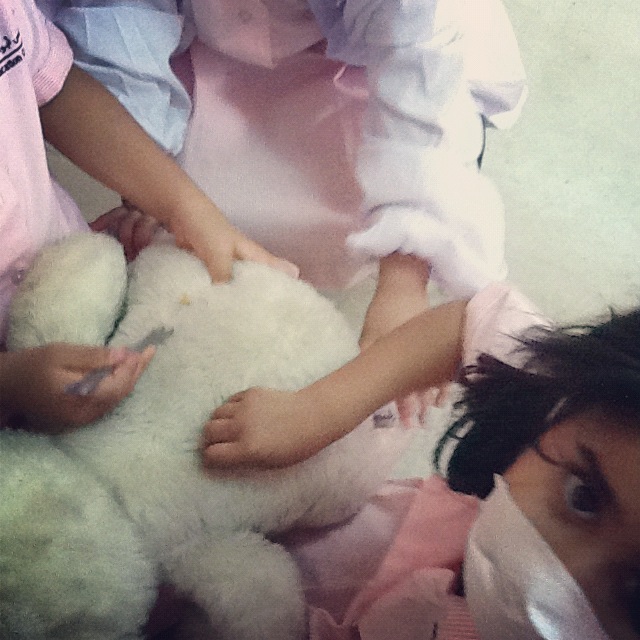
Bear Surgery

There was an emergency play dough removal that took place in our classroom the other day. . .


I'm sure the bear's the better for it :)

It amazes me what children come up with. A lab coat from the science center (must've had those masks still in the pockets), a wrench from the magnet station, and a teddy bear from the reading corner turned into something excellent.

I live for the brilliant, unexpected moments like these. Children are so incredible. What an honor to spend my days with these creative little humans.

Making Paper

We did this activity as part of our study on solids and liquids. It was also a great tie-in with our recycling theme the following week. I try to consciously incorporate "bridges" most weeks -- activities that suit our current focus but also link to whatever we're planning to cover the following week. It gives the children an additional reference point to help them connect with new learning.


After morning circle, we spent some time tearing old paper scraps (more leftovers from this project) into very tiny pieces and left them to soak in a tub of water.


A few hours later, the paper had absorbed a decent amount of water (and those big pieces in the photo above had been re-shredded!). I used an immersion blender to pulverize the wet scraps a little at a time. The children thought it looked like ice cream! (But we all agreed it was probably best not to take a taste.)

Unfortunately, there are no photos of the blending step, as I was teaching on my own this particular day. However, the fact that we managed to finish this project, just one teacher and 22 little ones, tells you how fun and easy it is!


Finally, we spread our paper mush out on some towels and patted it out like a pizza crust. We also pressed dish towels on top to absorb the excess water. Once our paper "dough" was nice and flat, we placed another thick towel on top, as well as some heavy bins. Two days later, voila -- we had paper! Not sure what we'll use it for yet, but I'll be sure to share once we figure it out!


Monday, April 23, 2012

Story of the Week: Stars

We spent last week exploring solids and liquids. Towards the end of the week, Salwa and I co-read the book Stars by Mary Lyn Ray, illustrated by Marla Frazee.

Because this book is a bit longer and requires some deeper thinking on the part of the children, it was easier for them to engage when listening in both languages. I'd start by reading a page in English, then Salwa would translate and clarify.

We found Stars to be a very soothing book; our class was drawn in slowly, calmly, one page at a time.


After reading we posed a question to the children: What is a star?

The children knew stars were neither solid nor liquid, and it was interesting to watch them contemplate the possible answers to the question. We touched briefly on the idea of gas (which we explored again the next day . . . but more on that later!). The idea wasn't to reach a concrete definition or give them any kind of direct explanation -- we just wanted to get them thinking and hopefully asking more questions.

As a follow up to the book and discussion, we explored a new-to-us process: bubble painting! 


We mixed dish soap, paint, and water in a small container, then used a straw to make colorful bubbles.


After giving the children plenty of time to explore the bubble-making process, we gave them star cutouts to make prints with the bubbles:


It was a great way link what we already knew about liquids with a new concept (our breath as the gas that makes the bubbles), and in the context of a beautiful story and project.

Yet another one we just can't wait to display!


Friday, April 20, 2012

Color Word Step Books

As the children's understanding of English has grown, their enthusiasm for reading and books has exploded! Inspired by this activity, I decided to have them make their own books (they loved it!), adapted to suit the needs and abilities of our class.

Here was our process:


1| Gather colorful rectangles in various sizes.


2| Layer them by size and staple together.


3| Match and glue the corresponding color word to each page.


4| Display as a beautiful banner for all to enjoy!

This past week we moved on to accordion books. The children just love the process of making something beautiful, familiar, and functional to call their very own. I do, too :)

Sorting Smarties

As part of our exploration of colors and color mixing last week, we worked on sorting Smarties in Numeracy. Because this activity encompassed a range of goals (sorting by color/matching, counting, recording and analyzing, reading), I worked with the children in small groups over the course of the week. This allowed for plenty of one-on-one time, and it gave me an opportunity to really see where each child was at.

I introduced the activity to the whole group and explained that we'd be sorting the candy by color, demonstrating this process. However, when working with the children in small groups, I didn't give them pointers or reminders right away. I simply handed them the materials (a counting grid and small tube of Smarties) to see what they would do. I wanted to know if they'd wait for instruction or jump in, if they could open the candy container by themselves, and then how they'd go about getting the candy out (which, I learned, can be a bit tricky!). Something as simple as this is great for developing and assessing children's problem solving skills.

The next step was to sort the candy by color. Some children simply placed the candy in a completely random way all over the grid. I let them go about their business for a bit, before clarifying that we were sorting by color and showing them how to compare a piece from the pile to a color already on the grid, ensuring that each row is a different color.


Some children worked horizontally, making equal rows to start.


Many understood right away what was expected and got to work.
I love watching the systems different children have -- how organized they are, what methods they employ, etc. It's just fascinating to me.


Eventually everyone successfully completed the sort. No one had any trouble with the 1:1 correspondence aspect (one candy piece per box).


After sorting their Smarties, the children counted each color, and I recorded their results. (Most of the children recognize numerals up to ten, but no one is really writing them yet.) In this way, the children were able to observe the written formation of different numerals as well as an important function of writing (to record and communicate). We also talked about which row had the most and which had the least. 


After counting, recording, and analyzing the results, the children read each sentence back with the help of the teacher. (Quite a few were able to recognize "I have" after the first few sentences and read the remaining ones independently.) This was a great way to practice sight words and color recognition. Most of the children were extremely focused on the reading process, and they seemed proud to be doing something so grown up.

And then, of course, there was the best part: Eating our Smarties!

Every child enthusiastically participated in this activity -- all aspects of it. Honestly, they seemed to enjoy the sorting, counting, and reading without giving a whole lot of thought to the eating part! I loved that I could observe a range of skills and help the children practice others, without a lot of stuff or fuss.