Showing posts with label counting. Show all posts

Sunday, May 27, 2012

More Recycling and Fishing Fun

We explored the concept of recycling in conjunction with our Magnets theme, and they actually complemented each other very well in many ways (just watch this video for proof).

During Numeracy one day, we had a (lighthearted!) can-stacking competition, which the children dedicated themselves to completely. It was a great way to practice counting, as well as comparison words like "tall" and "short".


Earlier in the week we'd gone fishing amidst the trash (including cans, paper, and plastic bottles) using a magnetic pole. We discussed how hard it was to find and catch fish with all the garbage in the way. Removing it from our pond was only the first step; the next day we sorted everything by type to practice proper recycling.

Our magnetic fishing game was a lot more fun without all that trash in the way!

As for the fish . . . they're simply made out of craft foam with paper clips attached. Each is marked with a different number of dot stickers, 1-10. After catching a fish, the children count the number of stickers, then match it to the correct numeral card.


I have several sets of numeral cards; this "counting" version allows the children to self-check when they're working independently.


I'll admit, it surprised me how excited the children were to engage with this activity on their own (and for quite an extended period of time), and it was excellent to watch several of them demonstrate mastery of the task. We've certainly come a long way since September!

Friday, May 18, 2012

Goldfish Cracker Numeracy

During our Sea Creatures focus, we did some counting using Goldfish Crackers, which I was surprised and fortunate to find in stock at Lulu's!

I laminated several counting mats for the children to use during small group time. (They were numbered one through six, though this could easily be extended. Not pictured are the mats I adapted by drawing on "counting dots" to assist the children that still have trouble recognizing all of the numerals.) The children simply counted out the proper quantity of goldfish to match the amount shown on each bowl. 


Another simple way to adapt this activity is to introduce a "control" (Montessori-style). Instead of simply setting out a whole bunch of crackers, you'd pre-count the exact number necessary to complete the task (in this case, 21 crackers). The children then have a way to self-check their results. 

We extended the activity by using some crackers for addition, too:


Using small-scale manipulatives in this way mirrored the activity we'd been doing in whole group. While most of our class is still building up the fine motor skills necessary to draw/write out an activity like this, quite a few are ready for the mental task itself. It could easily be completed using stickers and pre-made numerals for students to glue on in place of writing.

Here's what the process looked like during whole group (once again, similar to what we did here with eggs):


Writing out our carpet during whole group . . .

. . . and showing our work with pictures the next day (some of the children completed did this independently during small group as an extension).


Friday, April 20, 2012

Color Word Step Books

As the children's understanding of English has grown, their enthusiasm for reading and books has exploded! Inspired by this activity, I decided to have them make their own books (they loved it!), adapted to suit the needs and abilities of our class.

Here was our process:


1| Gather colorful rectangles in various sizes.


2| Layer them by size and staple together.


3| Match and glue the corresponding color word to each page.


4| Display as a beautiful banner for all to enjoy!

This past week we moved on to accordion books. The children just love the process of making something beautiful, familiar, and functional to call their very own. I do, too :)

Sorting Smarties

As part of our exploration of colors and color mixing last week, we worked on sorting Smarties in Numeracy. Because this activity encompassed a range of goals (sorting by color/matching, counting, recording and analyzing, reading), I worked with the children in small groups over the course of the week. This allowed for plenty of one-on-one time, and it gave me an opportunity to really see where each child was at.

I introduced the activity to the whole group and explained that we'd be sorting the candy by color, demonstrating this process. However, when working with the children in small groups, I didn't give them pointers or reminders right away. I simply handed them the materials (a counting grid and small tube of Smarties) to see what they would do. I wanted to know if they'd wait for instruction or jump in, if they could open the candy container by themselves, and then how they'd go about getting the candy out (which, I learned, can be a bit tricky!). Something as simple as this is great for developing and assessing children's problem solving skills.

The next step was to sort the candy by color. Some children simply placed the candy in a completely random way all over the grid. I let them go about their business for a bit, before clarifying that we were sorting by color and showing them how to compare a piece from the pile to a color already on the grid, ensuring that each row is a different color.


Some children worked horizontally, making equal rows to start.


Many understood right away what was expected and got to work.
I love watching the systems different children have -- how organized they are, what methods they employ, etc. It's just fascinating to me.


Eventually everyone successfully completed the sort. No one had any trouble with the 1:1 correspondence aspect (one candy piece per box).


After sorting their Smarties, the children counted each color, and I recorded their results. (Most of the children recognize numerals up to ten, but no one is really writing them yet.) In this way, the children were able to observe the written formation of different numerals as well as an important function of writing (to record and communicate). We also talked about which row had the most and which had the least


After counting, recording, and analyzing the results, the children read each sentence back with the help of the teacher. (Quite a few were able to recognize "I have" after the first few sentences and read the remaining ones independently.) This was a great way to practice sight words and color recognition. Most of the children were extremely focused on the reading process, and they seemed proud to be doing something so grown up.

And then, of course, there was the best part: Eating our Smarties!

Every child enthusiastically participated in this activity -- all aspects of it. Honestly, they seemed to enjoy the sorting, counting, and reading without giving a whole lot of thought to the eating part! I loved that I could observe a range of skills and help the children practice others, without a lot of stuff or fuss.

Monday, March 19, 2012

Patterns, Sets, and Addition: It's All Connected in 1-4

These past few weeks in Numeracy we've been working on combining equal sets (in other words, simple addition, as in: 2 + 2 = 4). But before we get to that, I'd like to show you some of the "building blocks" that made these lessons possible.

Shortly after we returned from winter break, we had our first experience with sorting objects into equal groups, or matching sets. We'd talked about items that come in "pairs," like socks, mittens, even our eyes and ears. Later, the children worked with partners (or, rather "pairs" :) ) to sort unifix cubes into equal groups. We drew lines down the center of small whiteboards to use as a sorting mat.

Each pair received two different colors, presented in one large group. While some ended up sorting their cubes by color, not everyone did, which was absolutely fine, as the goal was simply to make two equal groups of cubes. Classifying by color was an added bonus, and it helped with the next portion of our activity:


Making patterns! The children continued to work in pairs, and there was some great discussion going on as they worked out what, exactly, was the right way to do this. (I'll point out that we'd been working on AB patterns daily as part of our Numeracy circle time, as well as in various contextual, play-based ways.)

Later we used laminated sorting mats and plastic animal manipulatives to continue our work with equal sets. I showed the children how to check their work by drawing lines from the animals in the first column to those in the second, as Shadha demonstrates here:


It was great to see these types of sorting activities pop up during independent play! Here, Hamdan has resourcefully recreated the sorting mat and used his favorite toys (the sought after plastic jungle animals) to make equal sets. Great work!


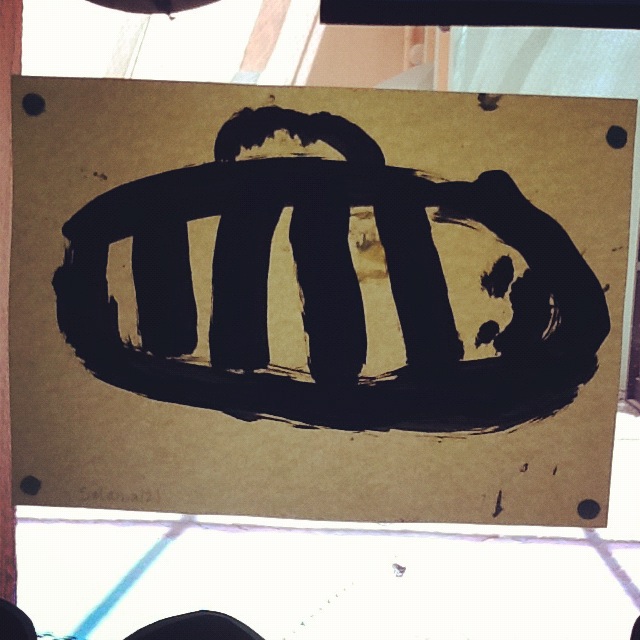
Our exploration of both patterns and equal sets continued as we began our Minibeasts unit: We painted striped patterns on bees . . .

by Salama


by Majed (top) and Hajer (bottom)

. . . and we made equal sets on the wings of ladybugs (or "ladybirds," going with the British form our school uses). The project you see a glimpse of below is a result of the children's independent work.


We began by drawing matched sets on the whiteboard -- so, if I put one spot on the right wing of a ladybird, a child volunteer would draw one on the left. If there were two on the right, there'd be two on the left, and so forth. We then counted the total number of spots on each ladybird (a bridge into, you guessed it, addition, or combining sets.) This presented a great opportunity to practice counting by 2's, so we made up a little chant:"2! 4! 6! 8! Who do we appreciate? Ladybirds, ladybirds, laaaaadddy BIRDS!" Throw in a few dance moves, and the children could count by 2's all day!

Following minibeasts, our topic was farm animals. Since we were also learning the letter "Ee" in phonics, counting and combining eggs was an excellent tie-in. It also gave us a chance to put our lovely nests to good use!

I started by setting out two nests on the carpet, each with an equal number of eggs (1, 2, or 3) inside. I told the children these were the eggs my chickens had laid and had them count the number in each nest, which was then written on the board. Now our job was to collect the eggs from both nests and put them in a basket to take home for supper.


After gathering all the eggs, we counted the total from our basket. Some children took the eggs one by one out of the basket as they counted . . .


. . . while others elected to dump all of them out and the systematically order and count them. Either way was, of course, absolutely fine!


You could almost see their eyes flash when they realized that if there were two eggs in each nest to start, there'd be four eggs in the basket.

Midway through the activity, one little boy was staring down at his hands, then suddenly gasped and turned to face me: "Ms. Emy! Ms. Emy! Five [showing me his left hand], five [showing me his right hand], TEN! [putting both hands up together]." How fantastic it is to see a child work something like this out on his own! (I mean, talk about extending patterns!)

Oh, and a side note: I made an equal number of brown and white eggs (using laminated paper, as plastic eggs aren't available here), which could then be used for additional sorting and patterning activities (i.e., sorting by color, making AB patterns). All in all, very integrated, and very useful! Some of the best maths we've done all year :)